Poisonous Mushroom Identification for Dog Owners
Posted by The San Francisco Dog Walker
⚠️ EMERGENCY WARNING: If you fear your dog or cat has eaten a poisonous mushroom, seek veterinary help immediately. They can go into a coma-like sleep within hours of ingestion or suffer severe liver failure. Time is truly of the essence.
Contact your veterinarian, a pet poison control center, or visit your local Animal ER.
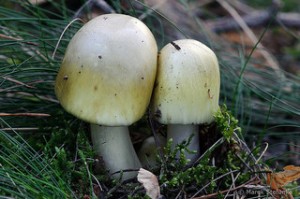
The Deadly Death Cap and Other Amanita Mushrooms
With names referencing death and destruction, it's no wonder the Amanita mushroom genus contains some of the most famous and deadly of all poisonous mushrooms. The death cap (Amanita phalloides) is suspected to have caused more mushroom poisoning deaths than any other species!
Yet what makes some Amanita mushrooms so poisonous? Certain species of Amanita contain amanitin, a deadly amatoxin.
Amatoxins are some of the most lethal poisons found in nature. These toxins work by slowly shutting down the liver and kidneys. Often the victim will appear sick at first, and then seem to get better. Unfortunately the amatoxins are still at work, and death may occur anywhere from a few days to a week after ingestion.
This poison knows no real antidote beyond treating the victim with an extract of milk thistle. Milk thistle protects against liver damage from toxins, and is one of the treatments for Amanita mushroom poisoning.
Despite this treatment, it's said that one cap of a death cap is enough to kill. Given the danger, we'd better learn some poisonous mushroom identification!
Remember: Never solely identify any mushroom based on what you've seen on any website (including this one) or by comparing it to a picture in a book. Always obtain hands-on expert help when identifying a new mushroom and never eat anything you're not sure of!
Death Cap Identification
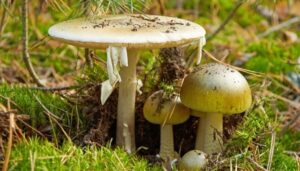
Cap Characteristics
- Convex initially but flattens with age, often sticky when touched
- Between 3 to 6 inches across
- Color is usually a shade of yellow to green, but sometimes white or brownish
- White gills underneath the cap that don't run down the stem
Stem Characteristics
- Between 3 to 6 inches across and less than an inch thick
- Usually whitish, sometimes with scales
- Often a ring around the stem right below the cap. This ring is the remnant of the partial veil, a piece of tissue that protected the mushroom's gills as it grew
- Also present is a white sac around the base of the stem. All Amanita mushrooms start their lives as small buttons in the shape of an egg. This egg-like covering is actually a layer of tissue called the universal veil, or volva
Because they form as a small button, an Amanita may sometimes be mistaken for an edible puffball. This is why it's essential to slice a puffball open before eating it. Puffballs are white and solid on the inside with no gills. If you see gills, you may have an Amanita on your hands.
Once the mushroom has grown, the sac-like remnants of this universal veil are still an important identification characteristic. It's often underground so you may have to dig carefully around the base to find it.
However, never assume that you don't have an Amanita mushroom just because you can't find the sac. It may have disintegrated or broken away. Use all features for poisonous mushroom identification, not just one!
Why Death Caps Are Dangerous to Dogs
Amanita phalloides, the death cap mushroom, has a sweet odor (like honey) and is attractive to some dogs whose owners report they actually seek them out to eat them. The toxic effects appear about 6-36 hours after the mushrooms are eaten, and once signs are seen the toxicity is poorly responsive to treatment. We try a lot of things to support the animal, but if enough mushrooms were eaten it will be fatal despite the treatment.
If someone suspects their dog may have eaten a mushroom, the best treatment is to take the dog immediately to a vet or emergency clinic and have them induce vomiting and give activated charcoal. The mushroom toxin is absorbed fairly rapidly, but the damage to the liver can take hours before it is clinically apparent. Don't waste time trying to figure out if the mushroom is toxic—speed in removing the mushroom from the digestive system is the most important thing in my experience.
Local San Francisco Bay Area Considerations
Although most San Francisco and local mushrooms are not poisonous, and those that are usually cause only digestive upset, Death Caps (Amanita phalloides) are aptly named. After an initial digestive upset, death caps prevent liver cells from regenerating. Within a few days after ingestion there are no new liver cells to replace the old ones, and liver failure occurs.
Death caps might look like small white mushrooms in the early stages, but mature mushrooms can grow quite large and they have a slight metallic, greenish look. I have seen death caps south of San Francisco and in the East Bay. There might be some in San Francisco.
Death Caps have WHITE GILLS (the radiating blades on the underside of the cap), while most of the "lawn" mushrooms have brown gills. At Fort Funston beneath the trees, I've spotted white-gilled mushrooms, but they have shaggy scales on the cap—not death caps, possibly Lepiota rachodes.
Don't take a chance with mushrooms, especially death caps. Always supervise your dog.
The Destroying Angel
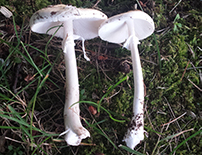
No page on poisonous mushrooms would be complete without discussing the death cap's deadly cousin, the destroying angel.
The term "destroying angel" actually refers to a few all-white poisonous mushrooms in the Amanita genus. They are:
- Amanita bisporigera in Eastern North America
- Amanita ocreata in Western North America
- Amanita virosa in Europe
Amanita virosa is known as the "European destroying angel". There is some disagreement as to whether this mushroom exists in the United States.
Destroying angels are sometimes mistaken for edible mushrooms such as young puffballs, button mushrooms, and meadow mushrooms. Thus it's important to learn how to identify them.
The destroying angel is very similar to the death cap in terms of identification. The biggest difference is that they're all white, with no green or yellow tint. They're recognized by their rounded base, white color, and smooth cap. One bite of these may contain enough amatoxins to kill!
Of course, not every species in the Amanita mushroom genus is poisonous. Some, such as Amanita caesarea (Caesar's mushroom), are edible. Yet given the danger involved in eating the wrong Amanita, it's best to avoid the genus entirely unless you really know what you're doing.
It's important to learn how to recognize Amanitas (especially the death cap and the destroying angel) if one is going to start eating wild mushrooms. Proper knowledge can prevent a fatal mistake!
Helpful Resources
- State-by-state list of mushroom experts who can help you with mushroom identification in poisoning cases
- "Death Cap" (Amanita phalloides) and other poisonous Amanita mushrooms
- General information on identifying Amanita mushrooms
- General identification of poisonous mushrooms
- Mushroom poisoning in cats and dogs
- Wikipedia entry: Amanita phalloides
As a San Francisco dog walker for over 19 years, I cannot stress enough how important it is to watch your dog around mushrooms, especially during the rainy season when they flourish. Death caps are found in our area, and they can be fatal. If you see mushrooms in your yard or on your walks, steer clear and keep your dog away.